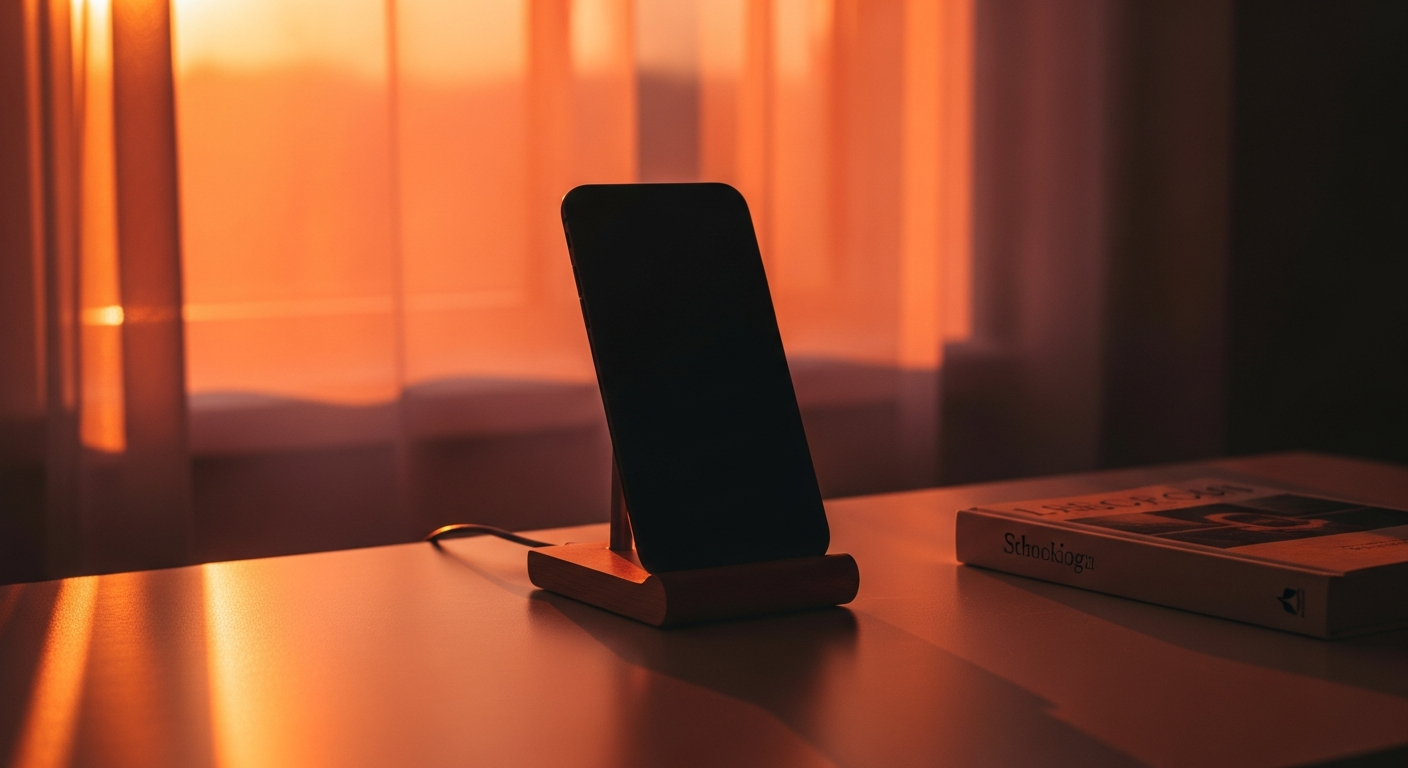
Digital Sunset: How Putting Your Phone Away at 9 PM Changes Everything
Of all the rules in 100 Sharp, this one might change your life most dramatically:
Phone on charger at 9 PM.
It sounds simple. Almost trivial. But for most people, it's harder than the workouts—and more transformative than the pushups.
The Problem We Don't Admit
Be honest: how do your evenings typically go?
For me, before starting 100 Sharp, it looked like this:
- 6:30-8:30 PM: Time with kids
- 8:30 PM: Kids to bed
- 8:35 PM: Pick up phone "for a minute"
- 8:36 PM: Check email
- 8:40 PM: Scroll LinkedIn
- 8:55 PM: Open Instagram "just to see"
- 9:30 PM: Switch to Twitter/X
- 10:00 PM: Watch Netflix (while also scrolling phone)
- 11:00 PM: Realize I didn't absorb the show
- 11:30 PM: "One more scroll" before bed
- 12:15 AM: Finally put phone down
- 12:45 AM: Fall asleep (blue light has wrecked my melatonin)
Sound familiar?
I was losing 3-4 hours nightly to a device designed by engineers whose job is capturing attention. Those hours weren't relaxation—they were low-grade anxiety mixed with algorithmic manipulation.
What Digital Sunset Actually Is
At 9 PM, you put your phone on its charger. In another room. And you don't touch it until morning.
That's it.
Not "check it every hour." Not "only emergencies." Not "keep it nearby in case." On the charger. Other room. Don't touch.
You can still:
- Watch TV or movies
- Read on a Kindle (airplane mode)
- Use a laptop for real work
- Listen to music
- Talk to other humans
You cannot:
- Scroll social media
- Check email
- Send "just one quick" message
- Fall into YouTube rabbit holes
- Doom-scroll the news
The First Week Is Hard
Let me be honest: the first week of Digital Sunset is uncomfortable.
You'll reach for your phone without thinking. You'll feel phantom vibrations. You'll wonder what you're missing. You'll be bored—and realize you've forgotten how to be bored.
This discomfort is important information. It tells you how dependent you've become on a device. Noticing this is the first step to freedom.
By Week 2, something shifts. You stop reaching. You start settling into the evenings. You remember what you used to do before smartphones.
By Week 4, you'll dread picking the phone back up. The silence becomes valuable.
What You Gain: The Numbers
Here's the math:
If you currently use your phone from 9 PM to 11 PM:
- 3 hours per night
- 21 hours per week
- 90 hours per month
- 1,080 hours per year
That's 45 days of waking hours spent on phone scrolling annually.
Digital Sunset gives you back:
- 180+ hours over 60 Sharp
- Time for actual reading (600 pages, 60 Sharp requirement)
- Time for real conversation
- Time for quality sleep
The Sleep Revolution
Blue light from screens suppresses melatonin production. This isn't disputed—it's biology. Your phone is actively fighting your sleep.
When you stop using your phone after 9 PM:
- Melatonin release normalizes
- You fall asleep faster
- Sleep quality improves
- You wake more rested
I went from 6-7 hours of fragmented sleep to 7.5-8 hours of deep sleep. My energy transformed. My workouts improved. My focus sharpened.
One rule. Cascade of benefits.
What To Do Instead
"But what will I do without my phone?"
Here's the beautiful problem: you'll have to choose deliberately. Instead of defaulting to infinite scroll, you'll do something with intention.
Options:
- Read your 10 pages (60 Sharp requirement anyway)
- Talk to your partner (radical concept)
- Play with your kids (if they're still awake)
- Stretch or do yoga (mobility work)
- Journal or reflect (process the day)
- Work on your skill (10-minute practice)
- Take a walk (outdoor time, no phone)
- Prepare for tomorrow (reduce morning friction)
- Actually watch the movie (without second-screening)
- Go to bed early (revolutionary)
Within a week, you'll find you have preferences. You'll discover what you actually want to do when you're not numbing yourself with a screen.
Practical Implementation
Where To Put Your Phone
Physical separation matters. "I'll just put it face-down on the table" doesn't work. You need it out of reach and out of sight.
Options:
- Charging station in another room
- Drawer in the entryway
- Kitchen counter (far from couch)
- Bedroom nightstand (but don't enter bedroom until sleep)
What About Emergencies?
Common objection: "But what if someone needs to reach me?"
Real answers:
- If it's a genuine emergency, they'll call your home phone or your partner's phone
- Work "emergencies" at 9 PM are rarely emergencies
- You survived without constant availability until 2007
If you're a doctor on call or have a genuinely unavoidable need for late contact, designate your phone for calls-only with Do Not Disturb allowing only certain callers.
What About Alarms?
Use a traditional alarm clock. They cost $15 and don't have Instagram. If you use your phone as an alarm, you've given yourself an excuse to pick it up before sleep and immediately after waking.
What About Reading On Your Phone?
Get a Kindle in airplane mode. Or read physical books. The goal is eliminating the possibility of "just quickly checking" something.
The Relationship Effect
Here's something I didn't expect: my marriage improved.
When you're both scrolling phones in the same room, you're not really together. You're parallel consumers. Digital Sunset forced actual conversation.
At first it was awkward. We'd forgotten how to talk without a screen to distract us. But within weeks, we were having conversations we hadn't had in years.
Same with kids. If they're still awake at 9 PM, you're fully present. Not half-watching them while scrolling. Fully there.
The Creativity Unlock
Boredom is underrated.
When your brain has no stimulation, it creates. It processes. It makes connections. Algorithms feed you content; boredom generates content.
After 60 days of Digital Sunset, you'll notice ideas arriving. Solutions to problems you hadn't consciously worked on. Creative impulses you'd suppressed with constant input.
Your brain needs empty space. Digital Sunset provides it.
Common Failure Modes
"I'll just check this one thing" — No. One thing becomes ten minutes becomes your whole evening. Cold turkey after 9 PM.
"I need to respond to this work message" — It can wait until morning. Very few things are actually urgent. Training people that you're unavailable after 9 PM sets healthy boundaries.
"I'm just using it for music/podcasts" — Use a dedicated device or set strict boundaries. The phone's danger is the potential for distraction, not the specific app.
"My friends only communicate through social media" — Text them earlier. Or call them. Or see them in person. Real relationships survive 15 hours of phone-free time.
After 60 Days
By the end of 60 Sharp, Digital Sunset won't feel like a rule. It'll feel like protection.
You'll dread re-engaging with nighttime scrolling. The peace of phone-free evenings becomes too valuable to sacrifice.
Many 60 Sharp completers keep Digital Sunset permanently. It's the habit that most dramatically improves quality of life.
Start Tonight
You don't have to wait for Day 1 of 60 Sharp to try Digital Sunset. Start tonight:
- 1.At 9 PM, put your phone on its charger
- 2.Put it in another room
- 3.Don't touch it until morning
- 4.Notice what happens
Do this for one week. Just one week. See how you feel.
Then decide if you want 60 days of that feeling.
Ready to reclaim your evenings? Start with 100 Sharp
Your phone will survive without you. The question is whether you'll thrive without it.
Sharp body. Sharp mind. Sharp life. No dull moments.